
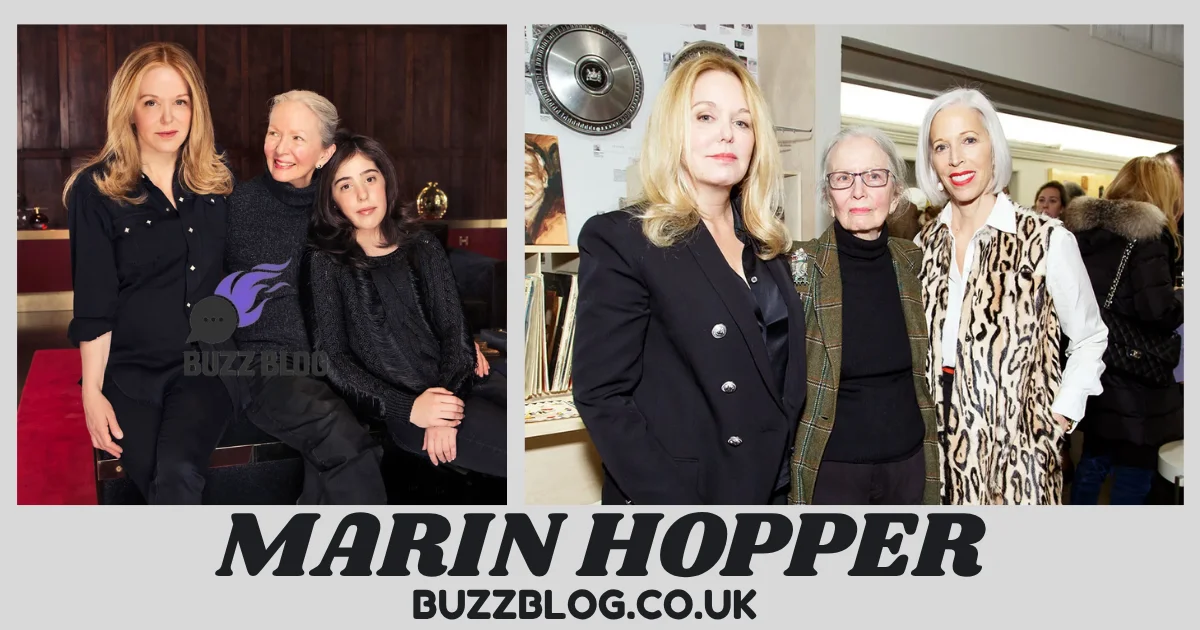
When people talk about the enduring mystique of Dennis Hopper, the conversation usually starts with films. It almost always circles back to Easy Rider, rebellion, New Hollywood, and the raw electricity he brought to American cinema. But through the work of his daughter, Marin Hopper, a broader picture has become impossible to ignore. That larger portrait reveals not only an actor and filmmaker, but also a serious photographer, visual thinker, and restless artist who used every medium available to document a country in motion.
Recent discussions around Marin Hopper’s stewardship of her father’s archive have renewed public fascination with his visual legacy. She has repeatedly emphasized that Dennis Hopper wanted to be remembered not merely as a celebrity with a camera, but as a legitimate photographic artist whose body of work stood on its own merit. Between 1961 and 1967, Hopper created roughly 18,000 images, capturing artists, actors, political protests, musicians, road culture, and ordinary American life with startling immediacy. That archive has since become one of the most compelling visual records of 1960s American cultural transformation. Marin Hopper has described opening those boxes of photographs after her father’s death as discovering something like “movie storyboards,” a phrase that instantly explains the bridge between his still photography and cinematic instinct.
This matters because Dennis Hopper’s photography does not merely supplement his film legacy—it helps decode it. The same man who framed highways, gas stations, civil rights marches, and faces behind windshields also built films obsessed with freedom, alienation, movement, danger, and America’s fractured promise. Through Marin Hopper’s perspective, the public has begun to understand that these were not separate creative identities. They were one continuous artistic vision.
Why Marin Hopper’s Perspective Matters
There is something uniquely revealing about hearing an artist explained by someone who lived inside the rhythm of that artist’s life. That is why Marin Hopper has become such an important voice in conversations about her father. Critics can interpret work, historians can place it in context, and audiences can project meaning onto it. But Marin Hopper offers access to the connective tissue—the emotional continuity between the private man and the public image. Her observations matter because they strip away decades of mythology and return Dennis Hopper to the realm of deliberate craft.
For years, the dominant cultural image of Dennis Hopper leaned heavily toward volatility, rebellion, and excess. He was often treated as the wild emblem of the American counterculture era. That reputation was not invented out of thin air, but it often overshadowed something quieter and arguably more durable: his discipline as an image-maker. Marin Hopper has repeatedly pushed back against the idea that photography was some side hobby attached to a movie star’s biography. Instead, she has described it as central to how he saw the world. Her comments frame the archive not as nostalgia, but as evidence of a serious creative intelligence working across mediums.
That perspective changes how we read his life. Suddenly, the photographs are not just beautiful artifacts from another decade. They become the architecture beneath the films. They show a man obsessively studying composition, gesture, emptiness, urban signage, faces in transit, and the emotional weather of American streets. If you want to understand why Dennis Hopper’s films feel so charged with atmosphere, it helps to know he spent years learning to trap life in a single frame first.
Dennis Hopper Beyond Hollywood
Reducing Dennis Hopper to actor alone is like describing a thunderstorm as “some rain.” Yes, he was a major cinematic presence. Yes, his work in Easy Rider changed American film history. But his career stretched across photography, painting, sculpture, collecting, and visual experimentation. He was less a specialist than a creative wanderer who seemed to distrust artistic boundaries.
Before many people recognized him as one of the defining faces of the New Hollywood movement, Hopper had already embedded himself within the emerging American art scene. He photographed figures connected to pop art, counterculture, and avant-garde circles. He documented names that would later become monumental in American visual culture. He was not merely orbiting these people because he was famous. He was there because he understood visual change while it was happening. That instinct matters. Plenty of artists arrive after the movement becomes history. Hopper was there while history was still improvising.
The richness of his career becomes especially clear when you compare his film work with his photography. Both reveal the same obsessions: roads, surfaces, outsiders, American rituals, and a country that often seemed both dazzling and unstable. It is almost as if cinema gave him movement, while photography gave him proof. One medium let him chase the pulse; the other let him freeze it. Through Marin Hopper’s efforts, this multidimensional legacy has become increasingly impossible to overlook.
The Rediscovery of the Photographic Archive
Few artistic rediscoveries feel as cinematic as the story of Dennis Hopper’s lost photographs. After his death in 2010, boxes containing prints and materials from his photographic years resurfaced, and the emotional effect of that rediscovery was profound. For Marin Hopper, it was not just an archival event. It was a confrontation with an entire visual autobiography that had been quietly waiting in storage.
The scale alone is staggering. Between 1961 and 1967, Hopper produced approximately 18,000 photographs. That number matters not because large archives automatically equal great art, but because it reveals relentless commitment. Nobody casually makes 18,000 images in six years. That is not dabbling. That is compulsion, inquiry, and discipline. The archive captured civil rights marches, roadside Americana, studio life, musicians, artists, lovers, strangers, and fragments of cities that now feel like archaeological evidence of another American century.
Why the Archive Changed Critical Opinion
The rediscovered work altered critical understanding of Hopper almost immediately. What many expected to be celebrity ephemera turned out to be something more substantial. The photographs displayed control, narrative tension, instinctive framing, and a sophisticated sense of visual rhythm. In some cases, they felt almost uncannily contemporary. The strongest images still breathe because they never feel staged. They feel overheard.
That is why critics increasingly stopped calling him an actor who happened to take pictures. They started treating him as a photographer whose archive happened to belong to a famous filmmaker. That is a significant shift, andMarin Hopper has been central to it.
Photography as Dennis Hopper’s Visual Language
To understand Hopper’s photography, it helps to forget the celebrity first. What stands out is not glamour but attention. His strongest photographs do not shout. They watch. They notice. A storefront becomes strangely poetic. A windshield becomes narrative architecture. A face in profile feels like a plot beginning. This is where the idea of photography as his visual language becomes useful.
Hopper often worked with an instinctive documentary eye. His images rarely feel over-designed. They carry the quick intelligence of someone who knows that life does not wait around for perfect light or ideal composition. That immediacy became a signature strength. His photographs frequently preserve the tension between accident and order—the exact place where human reality tends to live.
Critics have often pointed to the famous image “Double Standard”, now in the permanent collection of Museum of Modern Art, as one of the clearest examples of this intelligence. A seemingly ordinary roadside scene becomes something richer: a meditation on framing, signage, movement, and American identity. That kind of image tells you a lot about Hopper. He was not hunting only beauty. He was hunting meaning hiding inside surfaces.
The 1960s Through Hopper’s Lens
If you wanted a single visual diary of 1960s America, Dennis Hopper’s archive would be a serious contender. He photographed artists, musicians, actors, demonstrations, street scenes, motorcycles, diners, and the strange theater of everyday public life. Looking through the archive now feels less like reviewing photographs and more like stepping into a moving current of cultural transformation.
He photographed people such as Andy Warhol, Jane Fonda, Paul Newman, and figures connected to the Los Angeles and New York art scenes. But just as importantly, he photographed protest movements, civil rights marches, storefronts, and ordinary passersby. That democratic eye matters. It suggests he saw history not just in famous faces but in collective motion.
One of the most revealing facts is that Hopper photographed the 1965 Selma civil rights march. That single act expands our understanding of him. It places him not only inside artistic circles but also at the edge of historic civic upheaval. His archive does not romanticize the decade into pure bohemian fantasy. It captures a country alive with friction—beauty pressed right against instability. That tension would later become a central emotional engine of his films.
How Photography Shaped the Films
People often talk about Easy Rider as if it appeared from pure countercultural lightning. But the visual DNA of that film had been quietly forming years earlier through photography. The roads, gas stations, open skies, passing strangers, and sudden emotional distances that fill Hopper’s still images are already cinematic long before he started directing.
Motion, Distance, and the American Road
Easy Rider feels less like a conventional narrative than a chain of visual encounters. That structure resembles photographic thinking. Each moment lands almost like a still frame charged with atmosphere. A motorcycle crossing open space. A face lit by uncertainty. A landscape that feels simultaneously free and threatening.
This is why Marin Hopper’s “movie storyboard” observation resonates so strongly. Her description is not poetic exaggeration. It is practical truth. Hopper’s photographs trained him to see emotional geometry: how a road can symbolize freedom, how distance can become loneliness, how a face can carry social tension without speaking. Cinema simply gave him time, sound, and motion to expand what photography had already taught him.
Marin Hopper on Artistic Intent
One of the most important contributions Marin Hopper has made is clarifying intent. She has stressed that Dennis Hopper wanted his photography to be taken seriously—not as memorabilia, not as celebrity collateral, but as art worthy of museums and sustained critical engagement.
That distinction matters more than it may seem. There is a long tradition of famous actors being casually forgiven for mediocre visual art because fame creates curiosity. But the reaction to Hopper’s archive has increasingly moved in the opposite direction. The seriousness of the work demanded seriousness of response. Marin Hopper’s advocacy helped keep the discussion focused where it belonged: on image-making, visual intelligence, and historical value rather than personality mythology.
Her role has also been curatorial in the deepest sense. She has not simply preserved objects. She has shaped public understanding. Through exhibitions, books, and interviews, she has made it easier to see her father not as a chaotic icon who occasionally took photographs, but as an artist whose photography helps explain everything else.
Film Legacy Reconsidered
The standard version of Dennis Hopper’s film legacy usually revolves around rebellion. That is fair, but incomplete. Yes, he helped define a new cinematic freedom. Yes, he embodied anti-establishment energy. But if you only see rebellion, you miss structure. You miss the disciplined eye underneath the apparent chaos.
His films often feel alive because they are built by someone who understands how people inhabit space. That is a photographic instinct. A director can move actors around a set. A photographer learns how meaning emerges from placement, distance, interruption, and the accidental poetry of real environments. Hopper brought that knowledge into film.
When you revisit his legacy through the lens of photography, even the roughness of his films begins to feel more intentional. The jagged rhythms, abrupt cuts, and emotional unease become less like disorder and more like a refusal to smooth life into something false. That is one reason his work still feels modern. It trusts friction.
The Relationship Between Cinema and Stillness
One of the strangest pleasures in looking at Hopper’s photography is how many images feel unfinished—in the best possible way. They seem to imply a before and after. You look at a person standing beside a road and instinctively imagine where they came from and where they are going. That is cinematic thinking.
Still photography and cinema often get treated as separate artistic species. In Hopper’s case, they feel like two dialects of the same language. His photographs carry narrative tension, and his films carry photographic patience. A single still frame can feel like a withheld scene. A movie moment can feel like a photograph suddenly allowed to breathe.
That relationship helps explain why the archive matters beyond nostalgia. It reveals method. It reveals how Hopper learned to look. And once you see that, you start recognizing the same artistic fingerprints everywhere.
Dennis Hopper’s Legacy at a Glance
| Area | Key Contribution | Why It Matters |
|---|---|---|
| Photography | Around 18,000 images between 1961–1967 | One of the most vivid visual records of 1960s America |
| Film | Easy Rider and New Hollywood influence | Helped redefine independent American cinema |
| Cultural Documentation | Civil rights marches, artists, musicians, street America | Captured a society in artistic and political transition |
| Artistic Method | Shared visual instincts across mediums | Photography helps decode the films |
Conclusion
What makes the story of Marin Hopper discussing her father so compelling is that it does not merely preserve memory—it reshapes interpretation. Through her stewardship, Dennis Hopper emerges less as a cultural myth and more as a coherent artist whose photography, films, and visual instincts belong to one uninterrupted creative conversation.
His photographs captured America when it felt unstable, electric, unfinished, and wide open. His films carried that same weather system into motion. One medium froze the moment. The other let it drift down the highway. That is why the archive matters. It is not a footnote to the movies. It is the map that helps us understand how those movies came into being.
And maybe that is the most revealing thing of all. Dennis Hopper did not simply document an era. He taught himself how to see it.