
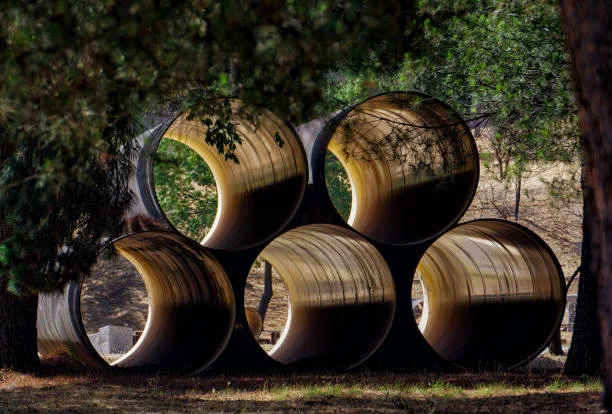
In the world of heavy industrial lifting, steel is revered for its strength. We build skyscrapers, bridges, and ships out of it. We assume that a 40-foot length of 24-inch diameter schedule-40 steel pipe is an indestructible object. To the human eye, it looks like a solid, unyielding iron log.
However, to a rigger or a structural engineer, a steel pipe is something entirely different: it is a balloon made of metal. And just like a balloon, if you squeeze it the wrong way, it loses all its structural integrity in a fraction of a second.
This catastrophic failure mode is known in the field as the “Taco Effect” (or officially as local buckling). It is the moment when a cylindrical pipe, suspended in mid-air, suddenly folds in on itself, turning a million-dollar asset into scrap metal before it ever reaches the trench. Understanding why this happens requires a deep dive into the invisible war between gravity, tension, and compression.
Discover a related insight that could reshape your perspective—read it now!
The Deception of the Cylinder
The cylinder is nature’s perfect pressure vessel. It is designed to hold immense internal forces (like high-pressure gas or oil) pushing outward. It is incredibly efficient at hoop stress.
However, a pipe is surprisingly weak when subjected to forces pushing inward or bending it along its length. When a long pipe is sitting on the ground, supported along its entire length, it is stable. But the moment a crane lifts it, the pipe becomes a beam.
If you lift a long pipe using a single pick point in the center, gravity pulls down on both ends. This creates a “negative bending moment.” The top of the pipe is being stretched (tension), and the bottom of the pipe is being squashed (compression). If the pipe is long enough and the wall is thin enough, the bottom wall will wrinkle, and the pipe will kink.
The Crushing Hug of Trigonometry
To avoid the “sag,” riggers often use a two-point pick with a bridle (two slings attached to a single hook). They attach the slings to the ends of the pipe to support it evenly.
This solves the sagging problem, but it introduces a new, deadlier enemy: horizontal compression.
This is simple trigonometry. When you have two slings angling down from a hook to the ends of a pipe, the force isn’t just pulling up; it is also pushing in. The wider the angle of the slings (the lower the headroom), the massive the inward force becomes.
Imagine holding a pencil between your index fingers and pushing inward. That is what the slings are doing to the pipe. If the angle of the slings is 60 degrees, the crushing force on the ends of the pipe is equal to half the weight of the load. If the angle gets flatter, say 30 degrees, the crushing force can actually exceed the weight of the pipe itself.
For a thin-walled pipe, this end-to-end compression is disastrous. It causes the walls to bulge and buckle. The pipe essentially tries to fold itself into a taco shape to escape the pressure.
The Point-Load Problem
Beyond the macro-physics of buckling, there is the micro-physics of the contact point.
When a wire rope sling or a chain is wrapped around a pipe in a “choke” or “basket” hitch, the entire weight of that section is concentrated on a line of contact only a few millimeters wide.
On a coated pipe—such as those used for oil and gas, which are wrapped in Fusion Bonded Epoxy (FBE) or concrete—this point loading is fatal to the coating. The sling bites into the protective layer, creating a “holiday” (a crack or hole). A pipe with damaged coating cannot be buried, as it will corrode. The result is costly downtime while the coating is repaired or the pipe is condemned.
Verticality is the Cure
The only way to lift a long, hollow cylinder safely is to ensure that the lifting forces are applied perfectly vertically.
If the lines connecting to the pipe are vertical, there is no inward crushing force. There is no trigonometry trying to shorten the pipe. The only force is upward lift.
Furthermore, to prevent sagging in the middle (the “noodle” factor), the lift points need to be spaced out efficiently to balance the center of gravity and minimize the bending moment.
The Mechanical Solution
This brings us to the engineering solution. To achieve vertical lift lines from a single crane hook, you cannot use simple slings. You need an intermediate structural device that takes the “crushing” force so the pipe doesn’t have to.
This is the function of the pipe spreader beam.
By introducing a rigid steel beam between the crane hook and the load, the rigging geometry changes. The angled slings from the crane pull on the beam, compressing it. The beam is designed to handle this massive compression. Meanwhile, the slings dropping from the beam to the pipe hang perfectly straight (vertical).
This configuration isolates the pipe from the crushing forces. It allows riggers to use multiple attachment points—sometimes lifting a pipe at four or six different locations along its length—to ensure it remains perfectly straight and stress-free.
Lifting with Intelligence
As modern infrastructure projects demand larger diameter pipelines with thinner walls (to save material costs) and more advanced, fragile coatings, the margin for error in rigging is disappearing.
The “old school” method of wrapping a choker around the center and hoping for the best is a liability. Understanding the physics of the lift prevents the “Taco Effect.” It ensures that the pipe arrives in the trench exactly as circular and pristine as it was when it left the factory, saving projects from the expensive sound of buckling steel.
Don’t miss our featured post—packed with insights you’ll want to act on today.