
The naming of a concept defines the way it’s practiced.
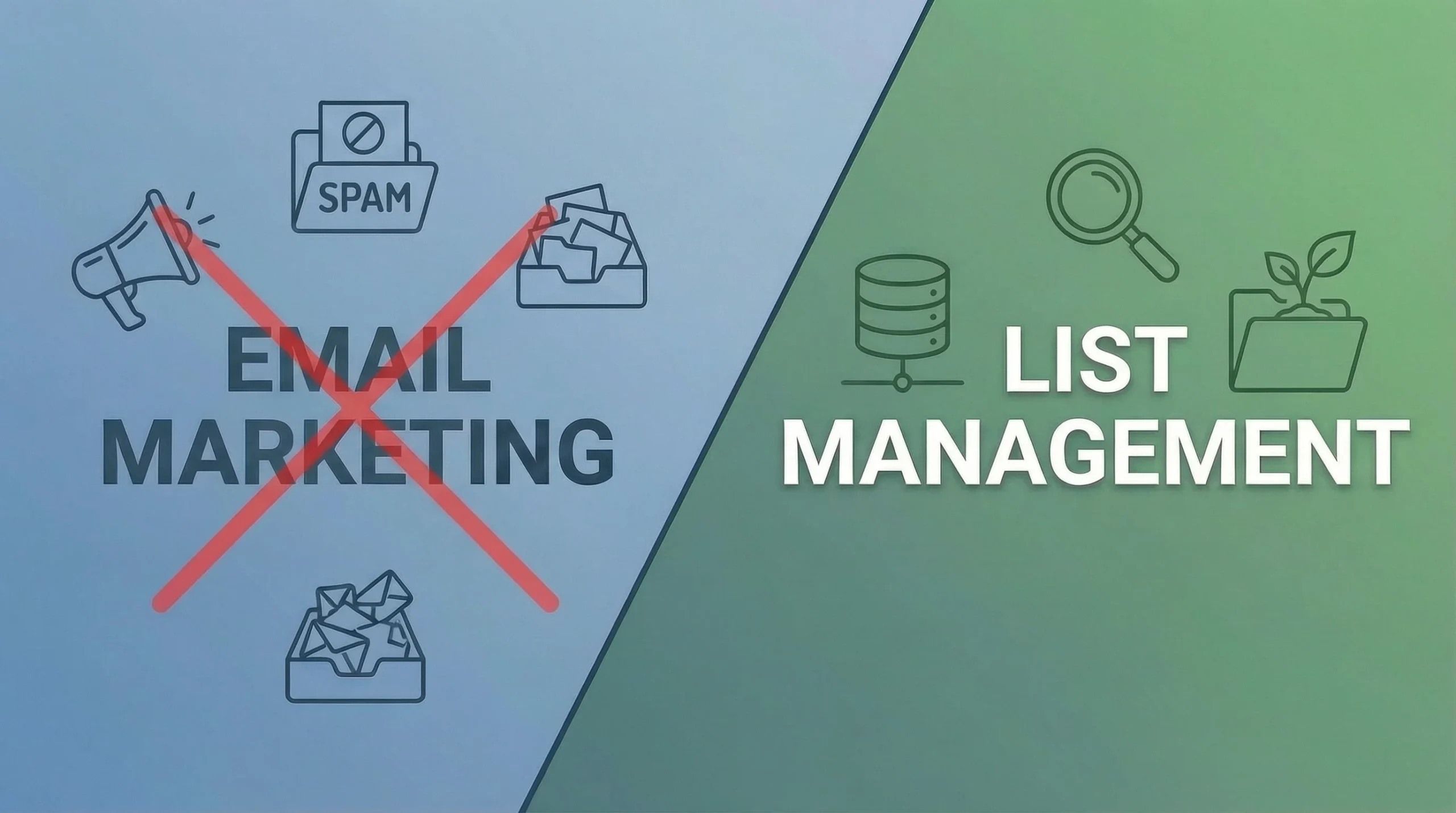
When entrepreneurs articulate their email ethos, they often describe it as crafting email campaigns and pressing send. This is what one may call Email Marketing, calling it by its proper name: List Management.
Words matter. When you hear email marketing, you probably think marketing with email, picture a newsletter editor and a send button. The conversation becomes about copy, subject lines, and how often you send. Those things are important. But they are not where most of the magic happens.
“Email Marketing = Sending Emails”?
For many, email strategy boils down to the simplest formula:
- Write email
- Send it to the list
- Repeat
We evaluate the success of a campaign on a campaign-by-campaign basis. Open rates go up and down. Click rates fluctuate. Tactics end up dictating strategy. This treats email like a broadcast channel. It fails to acknowledge that, while the tactics you use to send emails may be partially educating campaign performance, audience quality is what’s actually driving results.
If you’re just writing emails and broadcasting to a generic list, then sure, I guess call that “email marketing”. But on the whole, that’s not what the practice is really about.
“Sending emails” Is Only the Tip of the Iceberg
Sending emails to your list is the tip of the iceberg. It’s what users engage with and what charts in dashboards measure. The real work happens long before the send button is clicked.
- How contacts are being captured
- What information do you have access to about them
- How you’re segmenting your list
- How are you capturing behavior that will update their information?
By the time you hit that send button, 90% of the leverage is baked in. The email is the output of a well-structured system.
Email Marketing and “List Management”: One and the Same
The proper term for a really effective email discipline would be “List Management”. Now I don’t mean “managing a list in the traditional Sendy spreadsheet sense”. I mean, managing relationships with structured data.
Email marketing, when we peel back the layers, is the fine art of managing relationships with people over time. It’s about building a system where, at any moment, you can shoot a message to the right person…and not because you’ve guessed really well…but because the data told you so. Communication is the last output. It’s not the point of execution.
What List Management Actually Entails
- Demographic, behavioral, lifecycle, and engagement data to perform segmentation
- clear, consistent taxonomy
- Custom fields for relevant information
- Data capture, enrichment processes
- Opt-in, opt-out, consent, and compliance requirements
- Engagement tracking and lead scoring
- List hygiene, suppression handling, and inactive management
- Message personalization based on custom data
- CRM, checkout, webinar, and other tool integration
- Customer data syncing between platforms
- Performance tracking beyond open rates, including lifetime value, engagement tracking, and churn data
This is system architecture. This is how the operational mind thinks about email. Only once you’ve built the foundation should you be hitting send. Sending isn’t the effort. Send is the end result.
Why Sending Is the Wrong First Thought
When you frame email as “marketing,” sending becomes the goal. You start optimizing for the wrong things – inbox placement rates, open rates, CTR – without asking why those numbers look the way they do. Shift the frame to list management, and the questions change entirely. You’re no longer asking “how do we get more opens?” You’re asking “do we have the right people, the right data, and the right triggers in place?” The send becomes an output, not an objective.
That’s the difference between an email marketer and someone who runs a lifecycle program. One thinks in campaigns. The other thinks in systems. And the sends take care of themselves. Sending the message isn’t the strategy. It’s the result of the strategy.
Wanna manage your list properly and THEN send emails? Let me show you how!