
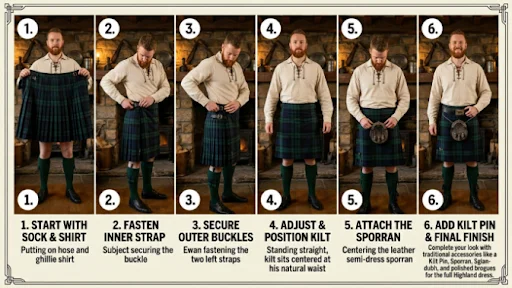
If your kilt arrives in the mail tomorrow and your event is on Saturday, you have less than a week to figure out something that takes most Scottish men years to fully internalize. Don’t panic — the process of putting on a kilt outfit isn’t actually complicated. It just has a specific order, and getting that order wrong is what creates most of the small mistakes beginners make or ghillie shoes.
The order matters because each piece sets up the next. Ghillie shoes go on first not because the shoes are most important, but because once the kilt is on, you can’t bend down comfortably to lace them. Kilt hose go on before the kilt for the same reason. Every step affects the next.
Here’s how to dress in a kilt outfit, from the ground up, in the order that actually works. Five minutes of reading. A lifetime of doing it right.
Step 1: Start With the Right Underlayer
Before anything visible goes on, decide what you’re wearing under the kilt.
Two real options for modern wearers:
Compression shorts or athletic underwear. Practical for daily wear, comfortable for sitting on chairs and benches, and the choice for almost all modern kilt-wearers. There’s no etiquette violation in wearing underwear with a kilt. The “regimental” tradition is purely optional.
Nothing (regimental). The traditional Scottish approach. Some events expect it (specific military regiments, certain pipe band uniforms). Most don’t. If this is your first time, wear underwear — you’ll be more relaxed and the experience will go better.
What to avoid: tight-fitting briefs that ride up, anything that creates visible lines through the kilt, anything bulky that distorts how the kilt sits.
Step 2: Put On Your Kilt Hose
Pull on your knee-high kilt hose before anything else.
Critical points:
- Pull them up to two fingers below the kneecap. Not higher (kills the silhouette), not lower (looks sloppy)
- Fold the cuff down 4 to 5 inches. Both legs identical
- Position the elastic garter inside the cuff fold. This is what holds the hose up
- Tuck the garter strap so it’s not visible from the front
If your hose came with garter flashes (small ribbons), thread them through the elastic garter so they peek out from below the cuff fold by 1 to 2 inches. Both legs should match exactly. The flashes hang on the outside of the leg, pointing slightly toward the side rather than the front.
For most events, cream or off-white hose with red flashes is the universal default. Don’t overthink it.
Step 3: Put On Your Ghillie Shoes (Loosely)
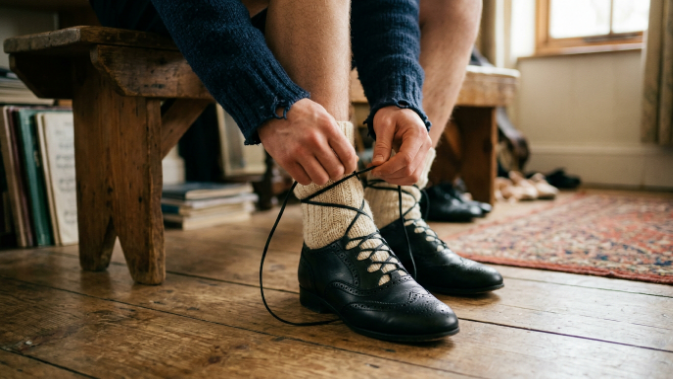
Lace your ghillie shoes loosely now, but don’t tie them yet. You’ll do that after the kilt is on.
Why now: once the kilt is wrapped around your waist, bending down to fully lace the shoes becomes awkward.
Why not fully tie yet: the long laces wrap around your calf and tie below the knee. If you tie them now and then put on the kilt, the kilt’s bottom hem will sit on top of the laces, hiding part of them. Better to tie after the kilt is in place so the laces sit cleanly relative to the kilt hem.
Lace them through the eyelets and let the long ends hang loose for now.
Step 4: Put On Your Shirt
Now your shirt and any underlayers go on. Yes, this seems out of order — but it’s actually correct.
You want your shirt fully tucked and arranged before the kilt goes around your waist. Once the kilt is buckled, tucking shirts becomes awkward and the tuck rarely sits cleanly.
For formal events, this means:
- White wing-collar dress shirt
- French cuffs if formal enough (slip cufflinks in now)
- Shirt tucked smoothly into your underlayer or just left long
For semi-formal:
- White or pale-colored long-sleeve dress shirt with banded collar
- Cuffs buttoned
For casual:
- Long-sleeve cotton shirt or button-down
- Tucked in for clean lines
Don’t put your tie or jacket on yet. Those come later.
Step 5: Wrap and Buckle the Kilt
This is the main event. Take your time.
The procedure:
- Hold the kilt with the apron (flat front panel) facing forward and the pleated section behind you
- Wrap the right side around your right hip first, then the left side overlapping on top
- The outer apron should be on your right side, with the open edge on the right side of your body
- Position the waistband at your natural waist at or just above your navel, not at your jeans-line waist
- Buckle the under-strap first (the inner buckle on your left side)
- Buckle the outer straps next (typically two on your right side; three for an 8-yard kilt)
- Adjust until snug but not constricting
The kilt should sit at your natural waist, with the bottom hem falling at the middle of your kneecap. If it’s hanging too low, the waist isn’t tight enough or you’re wearing it too low on your hips. If the hem is above your knee, the kilt itself is sized too short.
Once buckled, walk around briefly. Stand naturally. Sit down. The kilt should stay in place without you fidgeting with it.
Step 6: Now Tie Your Ghillie Shoes Properly
With the kilt in place, finish lacing the shoes. The technique:
- Cross the laces over the open top of the foot
- Bring both ends up the front of the leg
- Wrap each lace around the back of the calf, just above the ankle
- Bring both back to the front
- Tie a simple bow about four inches below the kneecap
- Tuck the loose ends behind the calf wrap so they don’t dangle
The bow position matters: roughly at the same height as your kilt hose flashes peek out. This creates visual symmetry across both legs.
If your laces are dramatically too long or too short, you can adjust by re-threading through the eyelets — sometimes skipping every other eyelet shortens the apparent length. Most ghillie shoes ship with appropriate lace length for average calf circumference.
Step 7: Add the Belt and Buckle
Slide your wide leather kilt belt through the loops over the kilt’s waistband. Buckle it firmly enough to feel secure but not so tight that it constricts.
The belt sits over the kilt, not under or beside it. The polished metal buckle should center directly over your navel — same as the kilt’s centerline.
Make sure the belt buckle’s metal tone matches your other metallic accessories: sporran chain, kilt pin, sgian dubh handle, jacket buttons. All should be in the same metal family (silver/chrome OR brass/gold OR pewter/antique).
Step 8: Put On Your Sporran
Drape the sporran chain around your waist, behind the kilt’s waistband. The sporran itself hangs at the front, centered just below the buckle.
Critical points:
- The sporran sits at navel level, not lower
- Center it under the belt buckle
- The chain runs behind the kilt waistband, not over it
- Adjust the chain length so the sporran hangs at the correct height
Most sporran chains have small links that allow length adjustment. The sporran shouldn’t bounce against the front of your thighs when you walk; it should rest cleanly at your lower abdomen.
For formal events: black leather with silver or chrome cantle (top piece).
For semi-formal: black or brown leather with simple metalwork.
For casual: plain brown leather day sporran.
Step 9: Pin the Kilt Pin
Place the kilt pin on the outer apron, on the right side (the side with the open edge), about 2 to 3 inches in from the right edge and 2 to 3 inches up from the bottom hem.
Crucial: pin only through the outer apron. Do not pin through both layers — this tears the under-apron over time.
The pin hangs vertically. Both sides should be visible, not pulled flat against the kilt.
Step 10: Tie Your Tie or Bow Tie
For formal events, tie your bow tie or four-in-hand tie now. Doing it after the kilt is fully wrapped means you can see your full silhouette in the mirror and ensure proportions look right.
The collar of your shirt should fully encircle the neck. The tie’s knot or bow should sit cleanly at the throat. The tie length should fall to the standard pant-belt level — but since you’re wearing a kilt, this means the tie reaches just above the kilt’s waistband. Tucking the tie tip into the kilt waistband is sometimes done at very formal events but isn’t required.
Step 11: Put On Your Jacket
The jacket goes on last. Put both arms through, settle the shoulders, and button it as appropriate for the jacket type:
- Argyll jacket: Single-button closure at the natural waist height
- Prince Charlie jacket: Worn open with no buttoning
- Tweed jacket: Single button closure for casual styling
Adjust the cuffs so they end at the wrist bone. The jacket should sit cleanly over the shirt and tie without bunching.
Step 12: Add the Sgian Dubh (Optional)
If you’re wearing a sgian dubh (“skee-an doo”), tuck it now into the top of your right kilt hose, with only the handle visible above the cuff fold. The blade should be fully sheathed and the handle should match your other metalwork.
Many modern wearers skip this for casual events and venues that restrict bladed accessories.
Final Check Before You Leave
Before walking out the door:
- Stand in front of a full-length mirror
- Hands at your sides, shoulders back
- Check the kilt hem hits the middle of your kneecap
- Check the kilt hose are even and the flashes match
- Check the ghillie shoes are tied symmetrically
- Confirm the sporran is centered under the belt buckle
- Confirm the kilt pin is positioned correctly
- Adjust the jacket and tie if needed
The whole process, from start to finish, takes about 10 to 15 minutes the first time. By the third event, you’ll be down to 6 minutes. The order is what saves time — doing it in the right sequence prevents do-overs.
This is how to wear a kilt the way Scottish men actually do it. Twelve steps. One direction. Always from ghillie shoes up.
Frequently Asked Questions
Can I put the kilt on first and the shoes second?
Technically yes, but it’s harder. Bending down to lace ghillie shoes once the kilt is wrapped is awkward, especially with the apron in the way. The standard order saves time and frustration.
What if my kilt feels too tight at the natural waist?
You may have ordered the wrong size. The kilt should be snug but not constricting. If it’s truly tight, professional kilt makers can let out the buckles slightly. Don’t try to wear it lower on your hips — that creates more problems than it solves.
How do I sit down in a kilt?
Approach the chair, smooth the apron under you with one hand as you sit, and let the pleats fall naturally behind you. Don’t sit on the pleats — they should hang behind the seat.
Can women wear kilts the same way?
Women’s kilts and kilted skirts work similarly, though the order of dressing varies based on the specific garment. The basic principles — natural waist sizing, proper hose, coordinated metalwork — apply equally.
How do I go to the bathroom in a kilt?
The same way as in shorts. The kilt’s open architecture is more practical than pants, not less. No special technique required.
What if I’m sweating after dressing?
The wool fabric breathes, so most sweat dissipates quickly. If you’re genuinely overheated, lighter weight kilts and lighter accessories handle hot weather better. Don’t wear a 16oz wool kilt with full Highland regalia in 90°F heat.
We built this Buzz BLOG just for you. Click here to see what we made with love.