
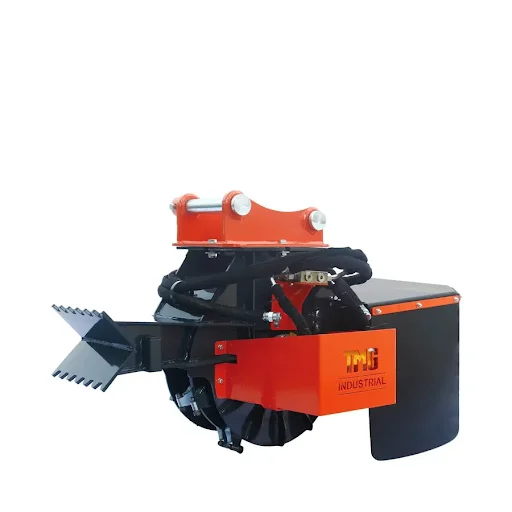
Introduction: Precision Land Clearing in Industrial Contexts
In the logistics and industrial sector, site preparation and maintenance are often prerequisites for expansion, storage yard reconfiguration, or infrastructure development. Leftover tree stumps from cleared land pose significant obstacles to material flow, vehicle navigation, and safe operations. The introduction of compact, high-torque attachments such as the 18″ Excavator Stump Grinder Attachment has transformed how warehouses and distribution centers approach land rehabilitation. This tool bridges the gap between heavy excavation and fine grading, offering a technical solution that eliminates physical barriers without requiring specialized standalone machinery. Its innovation lies in the integration of direct hydraulic drive systems and carbide cutting teeth, which enable precise depth control and reduce ground disturbance—a critical factor when working near existing paved surfaces or underground utilities.
Technical Overview and Common Applications
Stump grinding attachments for excavators operate on a simple yet effective principle: a rotating cutting wheel fitted with durable teeth grinds the stump into small wood chips below grade. The 18-inch model is specifically engineered for compact to mid-size carriers, typically in the 3 to 7 ton range. This makes it highly suitable for tasks in confined industrial yards, fence lines, and storage perimeters. Common methodologies include surface grinding to ground level or below-grade excavation to remove root balls for subsequent construction. The attachment utilizes the excavator’s existing hydraulic system to power the cutting wheel, allowing operators to leverage the boom’s articulation for precise positioning.
Prioritizing Efficiency and Operational Safety
For logistics managers and procurement specialists, the metric that matters is downtime reduction. A traditional stump removal method involving separate equipment or external contractors can halt site development for days. Using an excavator-mounted grinder streamlines the workflow: the same machine that clears brush or loads debris can complete the stump removal task. This consolidation directly impacts productivity. From a safety perspective, eliminating trip hazards and uneven surfaces in high-traffic warehouse zones reduces the risk of vehicle damage and personnel injury. The ability to grind stumps without leaving large excavation pits also minimizes post-operation backfill requirements, maintaining site stability.
Core Technology and Machine Capability
The effectiveness of a stump grinder attachment depends on several engineering factors. The 18″ model typically features a cutting wheel constructed from abrasion-resistant steel. Its torque is delivered via a hydraulic motor that must match the carrier’s auxiliary hydraulic flow and pressure. Key performance indicators include:
- Rotation speed – measured in revolutions per minute, affecting cutting efficiency.
- Tooth type and material – tungsten carbide tips offer extended wear life.
- Hydraulic compatibility – the excavator’s flow (liters per minute) must fall within the attachment’s operating range.
- Weight and dimensions – influence lifting capacity and reach, especially on slopes or near obstacles.
Operators must verify these parameters to ensure optimal performance and avoid undue stress on the carrier.
Variables Impacting Grinding Performance
Several site-specific conditions influence how effectively the grinder performs. Key factors include:
- Wood density and moisture – hardwoods require slower, more deliberate passes compared to softwoods.
- Operator technique – using the dipper arm to sweep the wheel in a controlled arc rather than forcing it downward prevents hydraulic strain.
- Cutting tooth condition – dull teeth increase cutting time and fuel consumption; regular inspection is essential.
- Ground conditions – rocks or embedded debris accelerate wear and create projectile hazards.
Safety Protocols and Industry Best Practices
Operating a stump grinder demands strict adherence to safety guidelines. Essential protocols include:
- Pre-operation inspection – check hydraulic hoses for leaks or abrasions; high-pressure fluid injection injuries are severe.
- Work area clearance – establish an exclusion zone to contain flying debris; keep all personnel at a safe distance.
- Personal protective equipment – hard hat, face shield or safety glasses, hearing protection, and high-visibility clothing are mandatory.
- Utility location – call for locates before any below-grade work to avoid striking buried cables or pipes.
- Controlled engagement – start at reduced engine RPM until steady contact is made, avoiding sudden impacts.
- Secure parking – when leaving the machine unattended, lower the attachment to the ground and engage safety locks.
Essential Equipment and Complementary Tools
Beyond the grinder itself, successful stump removal often involves ancillary tools:
- Hydraulic quick coupler – allows rapid switching between grinder, grapple bucket, and other tools, maximizing excavator utility.
- Forestry mulcher – may be used first to clear underbrush, followed by the stump grinder for final eradication.
- Maintenance tools – torque wrench for checking tooth bolt tension, and spare teeth for field replacement.
The 18″ attachment is designed to pair with compact excavators commonly found in industrial fleets, eliminating the need to rent or purchase dedicated stump cutting machinery.
Advantages and Operational Limitations
Advantages:
- Versatility – turns a standard excavator into a specialized land clearing tool, saving capital expenditure and storage space.
- Excellent visibility – compact profile allows the operator to see the cutting area clearly.
- Reduced ground disturbance – precise control minimizes damage to surrounding surfaces.
Limitations:
- Stump diameter – the 18-inch wheel size restricts efficient grinding to stumps within a certain diameter; larger stumps require multiple passes.
- Hydraulic dependency – machines with marginal flow will exhibit slower cutting speeds.
- Reach constraints – cannot access stumps in extremely soft ground where the excavator cannot safely travel.
Real-World Application: Warehouse Yard Rehabilitation
Consider a regional distribution center in the Pacific Northwest that acquired adjacent woodland for trailer parking expansion. The site contained dozens of fir stumps left from previous logging. Using a 5-ton excavator equipped with the 18″ stump grinder, the operations team completed the grinding in three days—a process that would have taken weeks using manual methods or subcontractors. The grinder worked below grade, allowing the new gravel base to be placed directly over the mulched material, which provided natural drainage. The project stayed on schedule and under budget because the in-house crew utilized existing equipment. This example highlights the logistical efficiency of integrating specialized attachments into standard industrial fleets.
Conclusion: Future Trends in Industrial Site Maintenance
As industrial real estate becomes more constrained, the ability to maximize every square meter of property will grow in importance. Attachments like the 18″ Excavator Stump Grinder Attachment represent a shift toward multi-functional equipment fleets. The future will likely see increased integration of telematics to monitor attachment usage and tooth wear, as well as improvements in cutting tooth metallurgy for faster processing. For warehouse managers and procurement professionals, investing in such attachments is not merely about stump removal—it is about maintaining operational readiness and ensuring that land assets are fully utilizable. Safety and efficiency will remain the twin pillars driving adoption, with a continued emphasis on operator training and adherence to best practice protocols.