
Introduction
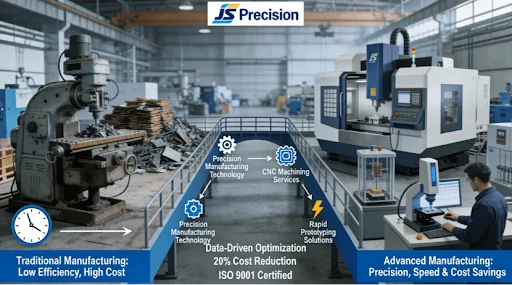
The manufacturing sector currently faces significant challenges of low efficiency and high costs. Traditional methods often fall short of meeting modern high-precision demands, leading to resource waste and project delays. These issues stem from technological lag, non-standardized processes, and a lack of customized solutions, which collectively diminish a company’s competitive edge.
This article explores how the integration of Precision Manufacturing Technology, CNC machining services, and rapid prototyping solutions provides a data-driven strategy for optimization, achieving both high efficiency and stringent cost control. The following sections will delve into how these technologies are applied in real-world scenarios.
What is the Core Advantage of Precision Manufacturing Technology?
Precision Manufacturing Technology represents a fundamental shift from conventional manufacturing. It encompasses a suite of Advanced Manufacturing Techniques focused on producing components with exceptionally tight tolerances and minimal deviations. The evolution of this technology has been driven by industries like aerospace and medical devices, where failure is not an option. Its core advantage lies in its ability to enhance both precision and efficiency simultaneously. By leveraging computer-controlled processes, it drastically reduces human error, ensures repeatability, and minimizes material waste.
The importance of standardization in this field cannot be overstated. Adherence to international standards, such as ISO 9001 (the global benchmark for quality management systems), is crucial. These standards provide a framework for consistent processes, rigorous inspection, and continuous improvement. For instance, implementing a standardized quality management system ensures that every part is measured and verified against strict specifications, effectively reducing errors and preventing costly rework.
How Do CNC Machining Services Optimize Production Flow?
CNC machining services form the backbone of modern automated production. These services translate digital designs into physical parts with unparalleled accuracy and consistency, directly addressing the pain points of manual labor-intensive methods.
The Role of Automation in Efficiency
The primary optimization comes from full automation. Once a design is programmed, CNC machines can operate continuously with minimal supervision, drastically reducing labor costs and eliminating variations caused by human fatigue. This automation ensures that every unit produced is identical to the first, achieving a level of consistency impossible to maintain manually. This is particularly vital for Custom Parts Production, where complex geometries must be replicated perfectly. The ability to maintain tolerances within ±0.005mm, as offered by leading providers, underscores the reliability of these services. Reports from authoritative bodies like the American Society of Mechanical Engineers (ASME) on manufacturing efficiency further validate the transformative impact of such automation on production throughput and quality.
Streamlining Custom and Complex Orders
For projects requiring specialized components, CNC machining offers unparalleled flexibility.
l From Design to Delivery
The process is streamlined from the start. Engineers can upload their CAD models and receive instant design for manufacturability (DFM) feedback, identifying potential issues before production begins. This proactive approach avoids delays and cost overruns.
l Case Study in Optimization
Consider the production of complex drive systems. A service provider’s expertise in Precision Gear Manufacturing Guide can be instrumental. By applying specialized CNC gear hobbing and shaping techniques, production cycles can be shortened significantly. A real-world case might involve producing a custom gear set for an automotive application, where the supplier leveraged advanced CNC protocols to reduce the lead time by 30% while improving surface finish quality.
How Do Rapid Prototyping Solutions Accelerate Product Development?
Rapid prototyping solutions are critical for compressing product development cycles. These technologies allow engineers to create physical models directly from 3D CAD data in a matter of days, or even hours. The value lies in enabling rapid iteration; designers can test form, fit, and function early in the design process, identifying flaws and making improvements long before committing to expensive production tooling.
This iterative process significantly reduces development time and cost. By avoiding the traditional method of creating hard tooling for prototype evaluation, companies can save weeks and substantial financial resources. Data shows that integrating rapid prototyping can lead to a 40% reduction in time-to-market. The reliability of these prototypes is paramount, especially in regulated industries. Companies which hold certifications such as AS9100D for aerospace quality management, ensure that even prototype parts are produced to the highest standards, providing dependable data for design validation and stakeholder reviews.
How Do Advanced Manufacturing Techniques Achieve Cost Savings?
The implementation of advanced manufacturing techniques is a proven strategy for achieving substantial cost savings without compromising quality. These savings are realized through multiple channels, including material efficiency, energy consumption, and reduced labor.
Material and Waste Reduction
Technologies like 5-axis CNC machining allow for the complete machining of a part in a single setup. This minimizes material handling and, more importantly, dramatically reduces material waste. By using near-net-shape stock and employing optimized tool paths, these advanced systems ensure that more raw material is converted into the final product.
The Energy and Labor Efficiency Equation
Advanced machines are designed for energy efficiency, and their high-speed capabilities reduce machining time, thereby lowering energy consumption per part. Furthermore, the high degree of automation reduces the direct labor required for production. A detailed calculation model might demonstrate that integrating these techniques can lead to an overall cost saving of 20% per unit.
A Model for Sustainable Production
The pursuit of cost savings aligns with sustainable manufacturing principles.
l Calculating the Savings
The savings are not anecdotal; they are quantifiable. For example, by optimizing cutting parameters and tool life, a manufacturer can extend tool longevity and reduce downtime, directly impacting the bottom line.
l Example: High-Volume Component Production
A practical example is visible in high precision gear manufacturing. By using precision machining services, a client can achieve higher gear quality and longer lifespan, reducing the total cost of ownership for the end-user. The National Institute of Standards and Technology (NIST) provides research that supports the long-term economic benefits of investing in such advanced, quality-focused manufacturing processes.
How Does Custom Parts Production Meet Diverse Needs?
The demand for Custom parts production is met through the flexibility of CNC Machining Services. This capability allows businesses to balance the economies of scale of large-volume production with the agility required for small-batch and highly customized orders. Digital tools are central to this flexibility. Cloud-based quoting platforms and real-time production monitoring enable manufacturers to respond quickly to client requests and changes.
This adaptability is crucial across industries. In the automotive sector, for instance, the IATF 16949 certification held by many suppliers demonstrates a commitment to quality and supply chain stability, which is essential for just-in-time manufacturing. Whether a project requires a single prototype or a million production parts, modern manufacturing services can scale efficiently, ensuring that diverse and evolving customer needs are met with speed and reliability.
Conclusion
In summary, the strategic integration of precision manufacturing technology, CNC machining, and rapid prototyping effectively addresses the core challenges of efficiency and cost in modern industry. This approach provides engineers and product developers with a sustainable, data-driven pathway to innovation and market success. For businesses seeking to enhance their project outcomes, exploring tailored manufacturing solutions is a logical next step. Companies like JS Precision offer the expertise and technological capability to transform these principles into tangible results.
Author Profile
The author is a senior manufacturing consultant with over a decade of experience, specializing in precision engineering and the application of international quality standards.
FAQs
Q1: What are the primary application fields for Precision Manufacturing Technology?
A1: This technology is critical in aerospace, automotive, and medical devices, where high-precision machining ensures component reliability, reduces failure rates, and enhances overall system performance.
Q2: How do CNC Machining Services guarantee quality consistency?
A2: Through automated controls and real-time monitoring, CNC services maintain tolerances as tight as ±0.005mm. Adherence to standards like ISO 9001 ensures every batch of parts meets strict specifications.
Q3: What is the typical timeframe for Rapid Prototyping Solutions?
A3: Depending on complexity, rapid prototypes can be completed within days, significantly accelerating design validation and avoiding weeks of delay associated with traditional prototype tooling.
Q4: Can Advanced Manufacturing Techniques be applied to low-volume production?
A4: Absolutely. These techniques are ideal for low-volume runs. Digital tools and flexible CNC systems make small-batch production economically viable, perfectly suiting custom and niche market demands.
Q5: How should a company select a reliable precision manufacturing partner?
A5: It is essential to evaluate certifications like AS9100D and review industry-specific case studies. A partner with proven technical expertise and a robust quality management system mitigates project risks.