
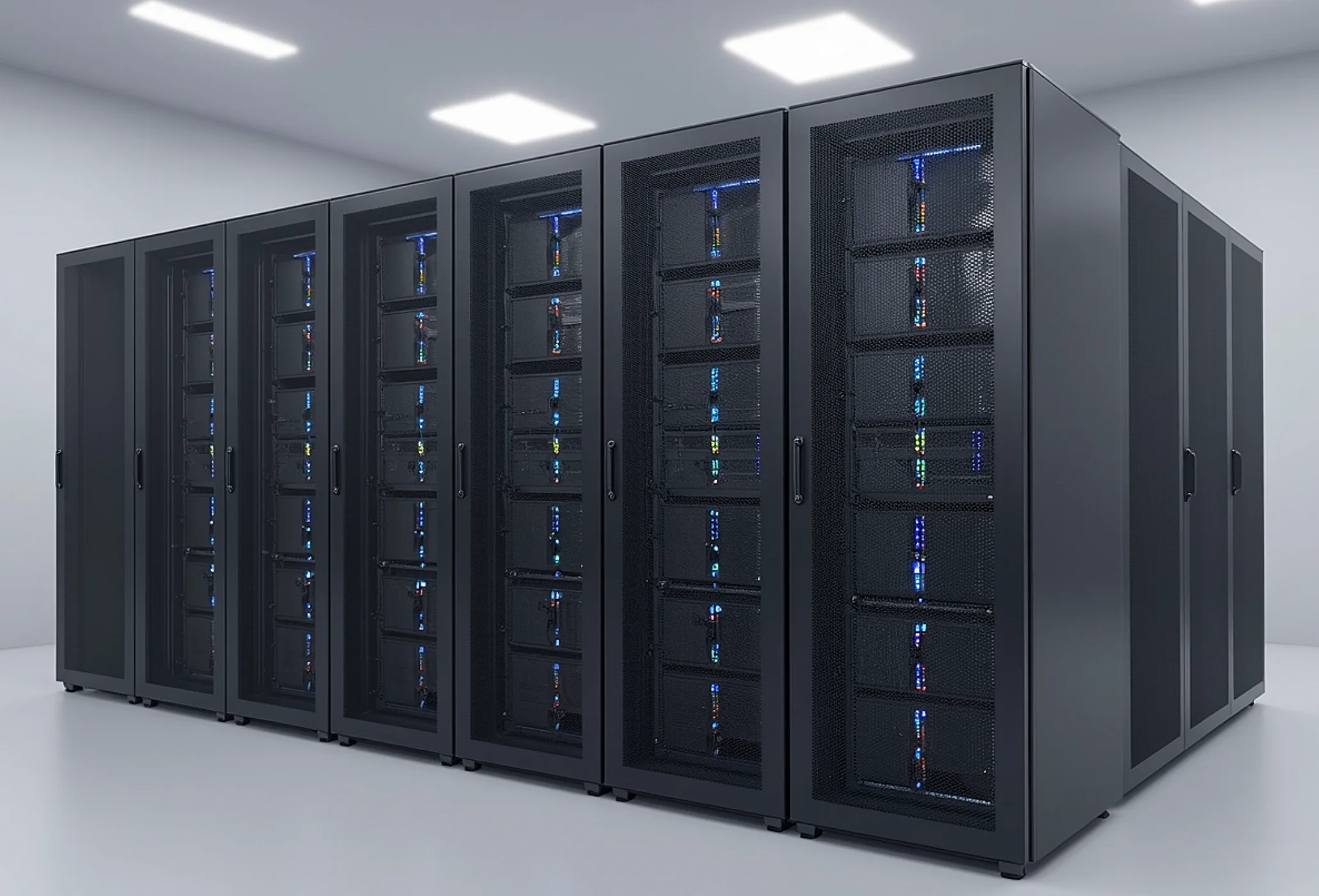
An in-house server room keeps companies alive—until the first serious incident strikes. The UPS lasts ten minutes, the air conditioning has no backup, and security ends with a standard lock. The comparison of server room vs. data center reveals a vast gap in downtime costs, security risks, and scalability. Secure colocation in a data center colocation environment provides multilayered defense against threats that a server room in-house simply cannot withstand.
Many companies still rely on their own infrastructure without realizing the true costs of insufficient redundancy and security gaps. The difference between a server room vs. a data center can determine business survival at a time when every minute of downtime costs tens of thousands of dollars. Discover why data center colocation offers a solution that truly protects.
Security risks—when an in-house server room fails
Cyberattacks, power outages, and unauthorized physical access—a corporate in-house server room faces threats it is often not prepared for. In 2025, the average global cost of a data breach reached USD 4.44 million, and in the United States as much as USD 10.22 million. Ransomware accounted for 44% of all incidents.
An in-house server room typically relies on a basic firewall, a camera system, and standard air conditioning. That is no longer sufficient. Attackers use artificial intelligence to create convincing phishing campaigns, and sophisticated malware bypasses traditional protection within minutes. A corporate server room with a single power feed and a UPS system lasting ten minutes represents a critical vulnerability.
Secure colocation within a data center colocation environment builds defense across multiple layers at once:
- Physical security begins at the perimeter with camera surveillance, continues with biometric authentication and segregated server rooms, and ends with individually locked racks.
- Cybersecurity protection ranges from advanced firewalls and IDS/IPS systems to data encryption.
- Continuous monitoring ensures specialists supervise the infrastructure 24/7 and identify suspicious activity before it causes damage.
The comparison of server room vs. data center in terms of security reveals a clear gap—while a server room in-house often has to “improvise” in critical situations, professional colocation facilities routinely meet ISO 27001 and SOC 2 standards as part of everyday operations.
Operational reliability—when backups are not enough
Electricity is the lifeline of every data center. Just a few seconds without power and servers crash, transactions disappear. Most server rooms in in-house environments rely on a single power source and a basic UPS that lasts only a few minutes—that is simply not enough.
Professional data center colocation operates with redundant architectures such as N+1 or 2N, meaning fully independent power paths. When the primary source fails, backup systems automatically take over the load without losing a single millisecond. Diesel generators maintain operations even during extended outages. The difference becomes evident during a storm—while the IT manager in an in-house server room anxiously watches alerts, specialists in the data center continue working calmly.
Servers generate enormous amounts of heat and can survive only minutes without cooling. Corporate server rooms rely on standard air conditioning without redundancy. Secure colocation in a data center colocation facility deploys multiple cooling circuits with hot-aisle/cold-aisle configurations. If one circuit fails, the others automatically take over. Advanced facilities monitor temperature in real time at the level of individual cabinets—whereas companies with their own server room typically discover a problem only after a collapse occurs.
Cost efficiency—the hidden costs of in-house operations
The initial investment in an in-house server room includes hardware, software, and infrastructure. This is followed by recurring expenses for electricity, cooling, equipment maintenance, and salaries for the internal IT team. Upgrades require purchasing new hardware and often result in significant downtime.
Data center colocation operates on a monthly fee model covering space, electricity, cooling, and network connectivity. Scalable options allow resources to be adjusted as needed without major capital expenditures. Shared infrastructure distributes energy and connectivity costs across multiple customers, who benefit from volume discounts. The absence of capital investments in buildings and facilities frees up a budget for strategic projects.
Compliance and continuity—when regulations decide
Compliance with industry standards is not optional. Organizations processing payment cards must meet PCI DSS requirements, healthcare institutions must comply with HIPAA, and financial institutions with DORA. A server room in-house requires internal audits, certifications, and continuous updates of security protocols—a process that is both time-consuming and costly.
Professional providers of data center colocation meet these standards as a routine part of their operations. ISO 27001, SOC 2, and other regulatory requirements are already implemented and regularly audited. With geographically distributed facilities, companies ensure that data remains accessible even in the event of a disaster. Real-time data replication and automated failover processes protect critical information and streamline recovery.
Tip: A detailed analysis of five specific data center security risks and the reasons why secure colocation is the optimal response can be found here.
Brief comparison: server room vs. data center
| Criterion | Server room in house | Data center colocation |
| Initial investment | High (hardware, infrastructure, construction) | Low (monthly fees) |
| Power redundancy | Single source + basic UPS (10 min) | N+1 or 2N, diesel generators |
| Cooling | Standard air conditioning without backup | Redundant circuits, hot/cold aisle |
| Physical security | Lock, camera | Biometrics, 24/7 security, multilayered protection |
| Cybersecurity protection | Basic firewall, antivirus | Advanced firewalls, IDS/IPS, 24/7 monitoring |
| Scalability | Limited by space and capital | Flexible, immediate resource expansion |
| Compliance | Internal audits, costly certifications | ISO 27001, SOC 2, PCI DSS already met |
| Disaster recovery | Backups in the same location | Geographically distributed facilities, real-time replication |
| IT staff | In-house team required 24/7 | External support, managed services |
| Average cost of data breach | USD 4.44M (global), USD 10.22M (USA) | Lower due to advanced protection and faster detection |
A decision that shapes the future
The server room vs. data center dilemma is not a technical debate—it is a strategic decision that affects a company’s competitiveness and resilience. Organizations that underestimate infrastructure security and reliability pay the price when the first serious incident occurs. Professional data center colocation means not only technological superiority but, above all, peace of mind and the assurance that the business continues to operate regardless of cyberattacks, natural disasters, or prolonged power outages.