
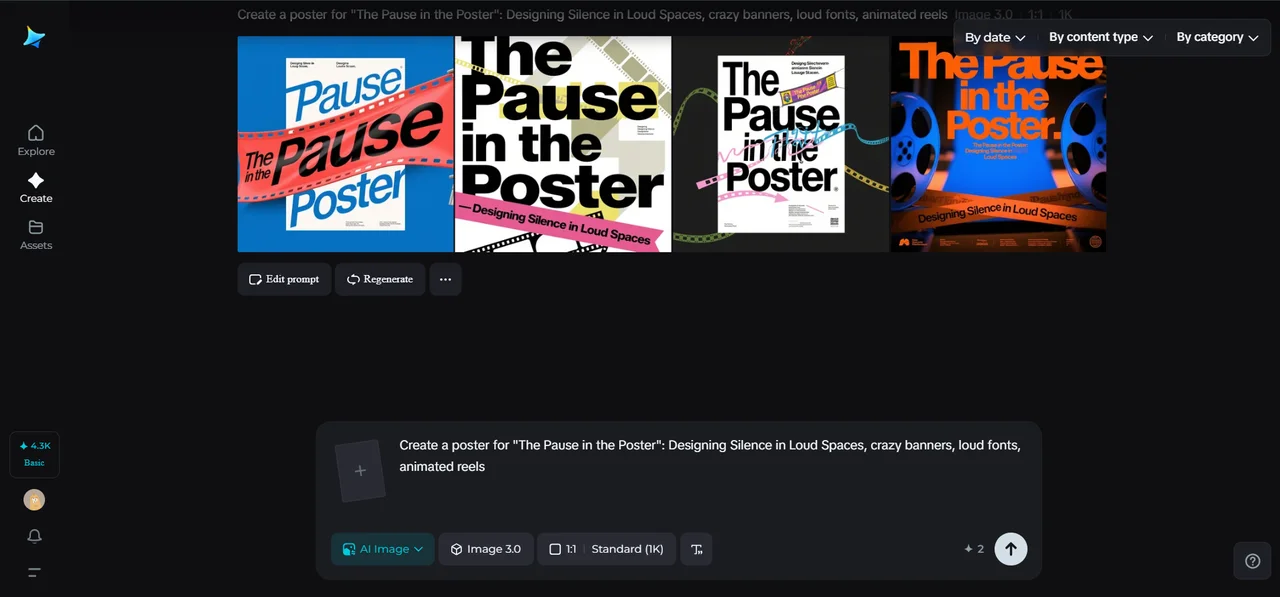
In a time when every surface competes for attention — crazy banners, loud fonts, animated reels — silence is truly the most luxurious rarity. But in design, silence is not the absence of sound; it is all about restraint. The most impactful posters and campaigns do not scream; they pause. They invite the viewer to breathe, linger, and feel.
Silence is to minimalist visuals what punctuation is. A clean background, one line of text, or one image often says much more than a collage of competing ideas. This is the power of negative space: that invisible area around the design that makes everything else speak louder. And now, with creative tools such as Dreamina and its AI image generator, designers can craft silence with intention: explore how simplicity, scale, and emptiness might turn a quiet poster into a magnetic visual experience.
Let’s explore how that stillness becomes storytelling, and how Dreamina can help you design that perfect pause.
The beauty of the unsaid – when less becomes more
The human brain seeks balance. When surrounded by clutter, it wants to find calm. For this reason, in a world full of visual noise, minimal design feels like a relief. Silence becomes its own message.
Think of the most memorable posters — they often feature:
- One central image framed by generous empty space
- A catch phrase or logotype that perfectly fits into the void.
- A soft color palette that allows negative space to breathe.
- Subtle play of shadows or light, without jarring effects.
It’s not laziness; it’s precision. A minimalist composition is making the viewer do something: pause, interpret, imagine. They create psychological ownership of the message. The silence between elements becomes an invitation to think, rather than only to look.
Emotional quiet: how silence builds connection
Visual silence works like emotional gravity. It doesn’t pull the eye aggressively—it draws the heart gently. When you strip away clutter, the remaining elements gain more weight. Every curve, every word, every tone suddenly matters.
Silence has been the move of a rebel in advertising. Amongst shouting campaigns, one poster whispers its way to being unforgettable. Empty space does not mean emptiness; it means intention.
Designers use negative space to:
- Create focus by isolating important elements.
- Suggest elegance through precision and restraint.
- Build emotion with subtle contrasts and calm compositions.
- Empower text and imagery by wrapping them in silence.
When well used, this quietness can turn any ad into poetry.
Design flow for creating the perfect pause by Dreamina
Step 1: Compose a text prompt
Start by navigating to Dreamina and constructing a prompt that describes your vision for visual silence. Think about composition, space, and atmosphere instead of excess detail.
For example: A minimalist poster with a white background featuring one red apple in the center, soft shadows, and elegant typography below — cinematic lighting with a serene tone.
This sort of detailed prompt tells Dreamina what to leave out as much as what to include. The absence becomes part of the art.
Step 2: Refine parameters and generate
Once your prompt is ready, modify the parameters that shape your design. Choose an appropriate model, refine your aspect ratio (portrait for posters works wonderfully), and size and resolution either to 1K or 2K for that clear detail. Then, hit Dreamina’s icon to generate.
Step 3: Modify & Download
Whenever your visual shows up, delve into the Dreamina options available for AI customization in perfecting the pause; Inpaint removes unwanted distractions, while Expand gives your composition more air. Use Remove for cleaner isolation or Retouch to soften tones or shadows. Once you are happy with the stillness and balance, tap the Download icon to save your final artwork.
How silence looks in motion
Stillness isn’t reserved for posters. Within motion design, the notion of visual silence plays an important role. The use of a pause during animation, a slow fade, or an extra breath between cuts fosters anticipation: the kind that keeps audiences watching.
That’s where the AI video generator comes in. With the video features available at Dreamina, designers can extend that stillness into motion: let the shadows creep along slowly, the gradients shift ever so subtly, and elements appear one at a time instead of all at once.
The quiet rhythm of motion forms a kind of storytelling in itself-a cinematic pause, if you will, to capture emotions better than chaos ever could. Picture a product reveal where the brand logo fades in, very slowly, over a field of white. No music. Light, space, and anticipation. That moment of visual silence becomes the sound of confidence.
The psychology of emptiness in design
Negative space is not a passive background; it’s an active storyteller. It defines the rhythm, directs emotion, and provides your audience with the mental space to absorb meaning.
Psychologically, visual silence has profound effects:
- It reduces cognitive load to a level at which viewers can process information calmly.
- It triggers curiosity; the brain fills in what’s missing.
- It builds trust by signaling confidence, since brands that pause aren’t desperate for attention.
This is a principle that applies everywhere — from a perfume ad with a single floating bottle to a campaign poster that says almost nothing. Silence turns design into conversation.
The paradox of minimalism: how emptiness feels full
Minimalism isn’t about subtraction, but rather precision. Every empty inch in a design has a purpose. Space around an object speaks to it, providing presence and gravity.
When brands adopt minimalism, it’s a way to say to their audience: We know what really matters, and we won’t waste your time. That confidence resonates across industries, from tech to fashion to lifestyle design.
Dreamina renders this process experimental and intuitive: innumerable variations of quiet, from light-drenched poster layouts to dark, moody, spatially hinting ones, can be imagined through the AI art generator. Where emptiness becomes expression and simplicity an emotional signature.
When silence sells
In marketing, silence can be more persuasive than sound. A clean design does not need to scream because it knows its value. That is why the best of the iconic campaigns leave room to breathe, just so the audience can feel.
Some of the most powerful visual ads in history are based on this concept: a single product, clear space, shadow, calm typography. The viewer fills the silence with emotion. That’s not absence — that’s engagement.
Conclusion: The art of the deliberate pause
Designing silence is about trust-trusting your audience to notice the quiet details, and trusting your message to stand without decoration. In that pause lies power, elegance, and clarity.
Silence is a tool for creativity, rather than a limitation, with Dreamina. Be it the creation of a minimalist poster, an ambient reel, or an art-inspired campaign, its AI image generator, AI video generator, and AI art generator let you explore how emptiness can hold emotion. Because in the end, the loudest posters aren’t always the ones that shout. Sometimes it’s the quiet ones — the ones that pause — that echo the longest.